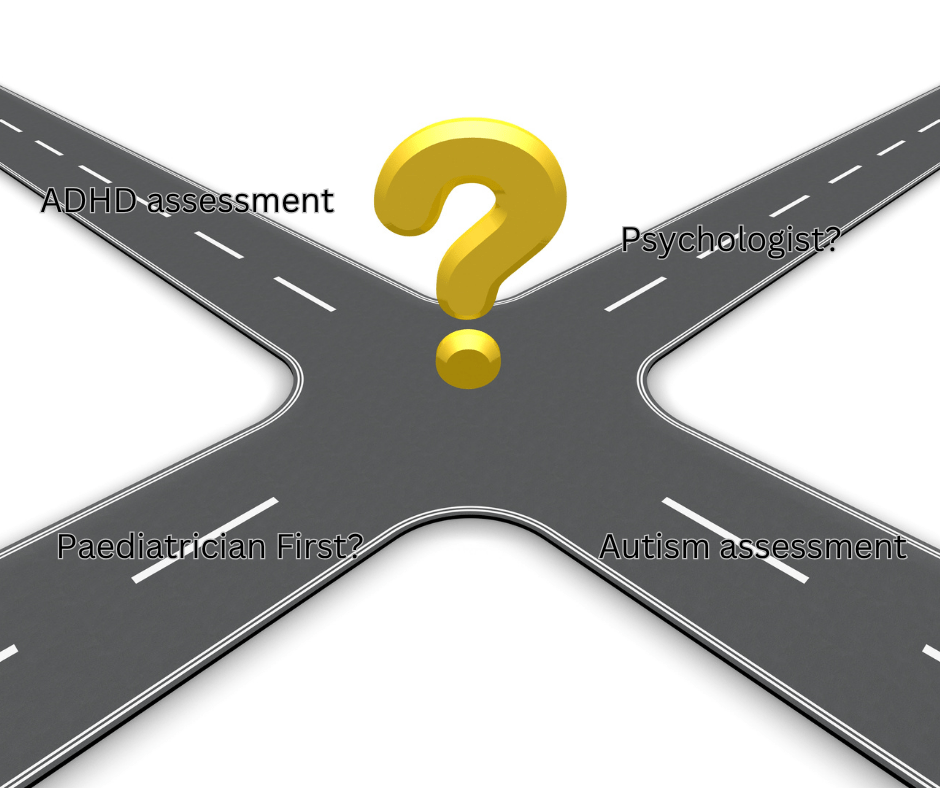
When I first started the process of getting my child assessed, I was completely overwhelmed. It’s a lot, especially when you’re not sure what’s causing your child’s challenges. In our case, it wasn’t immediately clear whether ADHD, autism, or something else was behind it all, so we had to explore different possibilities before things started to make sense.
The best place to start is usually with a paediatrician referral. However, long wait times often mean you’ll need to seek support elsewhere while you wait. That’s okay – there are still ways to start the process and gather helpful information early on.
Where to Begin: ADHD or Autism First?
It’s important to think about the best order to approach things. For us, that meant starting with an ADHD assessment and getting medication in place before moving on to an autism diagnosis.
Why? Because ADHD traits can often be more noticeable and sometimes mask or overlap with autism traits (at least that’s how it played out for us).
ADHD Assessment: What to Expect
An ADHD assessment can be completed by a psychologist. It typically involves:
- A parent questionnaire
- A teacher questionnaire
- An in-person assessment of your child
In our case, we completed the forms before the appointment, attended a face-to-face session, and then about six weeks later had a follow-up appointment to go through the psychologist’s detailed report.
The cost was around $950, and although it’s not cheap, it gave us so much clarity about our daughter’s behaviour and learning style.
Just remember that psychologists can’t prescribe medication. If your child needs medication, you’ll still need to see a paediatrician. Fortunately, our paediatrician reviewed the report, agreed with the findings, and could clearly see that our daughter had ADHD.
Autism Assessments: Single vs Dual Options
When it comes to an autism assessment, you generally have two options — a single or dual assessment.
A single assessment can be completed by a paediatrician or psychologist and usually includes questionnaires, observations, and interviews. This option is typically cheaper (under $1000), but it’s not accepted by the NDIS or by some autism support services such as Autism SA.
Dual Assessment: The More Comprehensive Option
A dual autism assessment involves two professionals — often a psychologist and a speech therapist (or similarly qualified clinicians). Your child will see both over one or two sessions, which may include questionnaires, cognitive or language tasks (like Theory of Mind testing), and structured observations.
You might be told the outcome right away, but often you’ll wait 6–8 weeks for the full written report.
From our experience, we paid $1800 with one clinic and $1950 with another. If you can get a paediatrician referral before the assessment, you’ll receive about a $400 Medicare rebate, which helps offset the cost.
Once you have that comprehensive report, you can:
- Apply for NDIS funding
- Access school supports
- Apply for Centrelink payments (if eligible)
For example, the Carer’s Payment is a fortnightly payment for parents of children with disabilities. It’s not means-tested and can also make your child eligible for various concessions — definitely worth looking into.
Taking One Step at a Time
There’s no sugar-coating it – this process can be expensive and emotionally exhausting. The public system is so overloaded that it’s often not a realistic option for many families.
So, it’s worth taking a step back, looking at your situation logically, and deciding which assessments are most important to do first.
Take it one step at a time, get support where you can, and remember that there’s no right way order to do things, just the one that works best for your family.
And don’t forget, there are intermediate supports available through your GP (I’ve covered this in my previous post on first steps).

 The Adjusted Life
Leave a comment